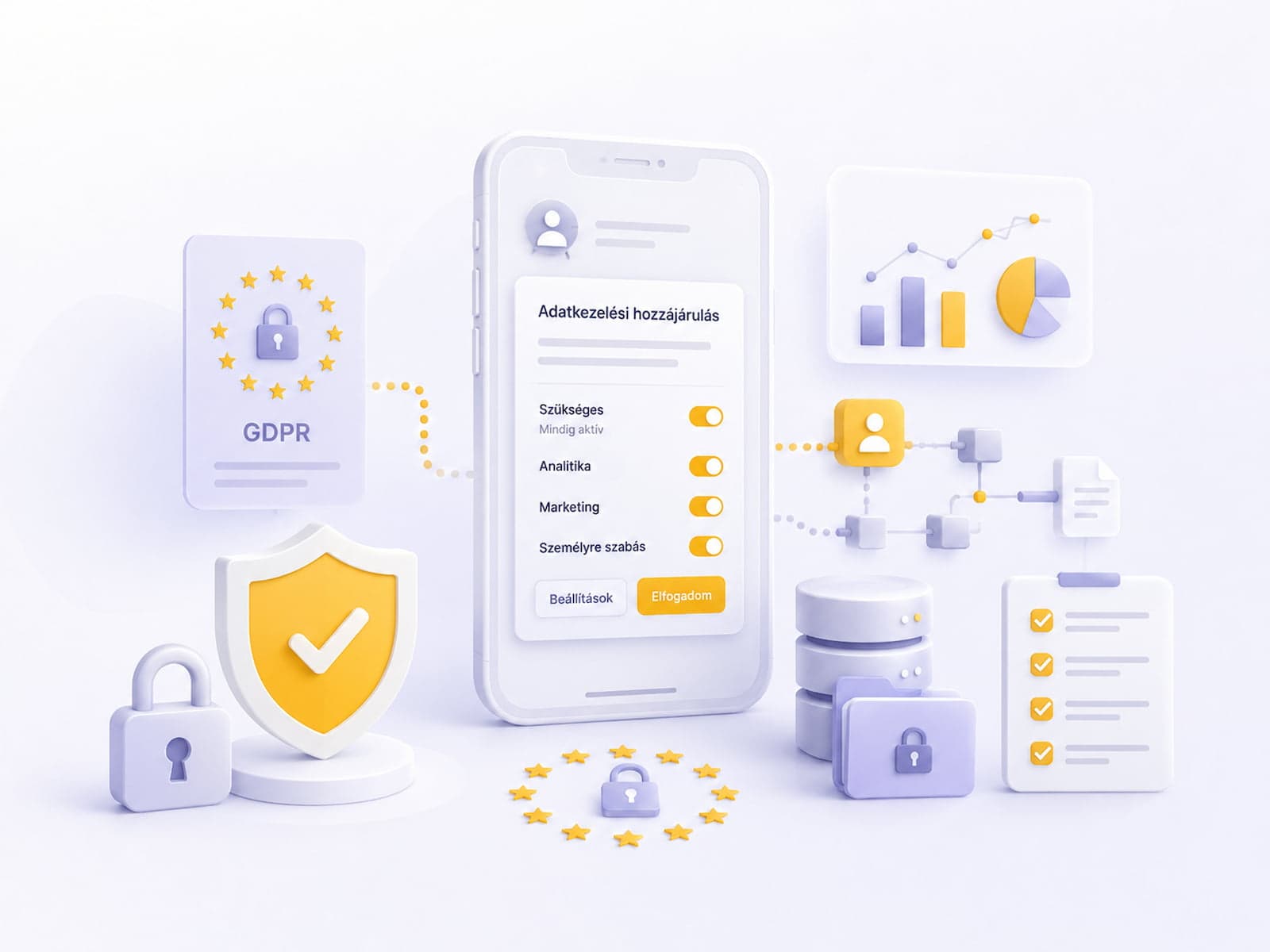
GDPR came into force in 2018, and by 2026 it is a baseline expectation for every mobile app on the Hungarian market too. Fines can reach 4% of annual turnover — for an SME, that can be enough to shut the business down. This article covers the most common compliance gaps with code-level examples, and also walks through the 2024-2026 privacy updates (Apple ATT, Google Privacy Sandbox).
This guide does not replace legal advice — a DPIA (Data Protection Impact Assessment) or a DPO (Data Protection Officer) consultation is mandatory for any complex project. But the developer-level best practices are summarized here.
GDPR basics in a mobile context
GDPR applies to personal data — anything that can identify an individual. On mobile, this can include:
- Email, phone number, name
- Location (GPS, cell-tower, or Wi-Fi triangulation)
- Device ID (IDFA, GAID, Android ID, IMEI, MAC address)
- IP address (yes, an IP address counts as personal data under GDPR)
- In-app usage analytics (can be anonymized, but often isn't)
- Push token (can directly identify a device, and through it a user)
- Browser fingerprint
- Biometric data (Face ID, Touch ID — even when processed only locally, not server-side)
The 6 core principles
GDPR Article 5 sets out six core principles. All of them must be explicitly upheld:
- Lawful basis — every processing activity needs a legal basis (consent, contract, legal obligation, vital interest, public task, legitimate interest)
- Purpose limitation — data may only be used for its declared purpose
- Data minimization — collect only as much data as necessary
- Accuracy — data must be accurate
- Storage limitation — retain data only as long as necessary
- Integrity and confidentiality — secure storage, encryption
The 8 user rights
Under Articles 12-22, users have the right to:
- Be informed (Articles 13-14)
- Access (Article 15 — Subject Access Request, SAR)
- Rectification (Article 16)
- Erasure (Article 17 — the "right to be forgotten")
- Restrict processing (Article 18)
- Data portability (Article 20)
- Object (Article 21)
- Be exempt from automated decision-making (Article 22)
Every one of these must be implementable in-app. The "right to erasure" doesn't mean the user can only request it by email — the app needs an actual button for it.
Consent management in detail
Consent has four requirements: freely given, specific, informed, unambiguous. A single "I agree to the terms" checkbox is not GDPR-compliant — every specific processing purpose needs its own consent.
The 2024-2026 update — granular consent
The 2024 EDPB (European Data Protection Board) guidance explicitly tightened the ban on "bundled consent." A single "I accept" button covering everything is no longer sufficient.
NOT GDPR-compliant:
☐ I accept the terms of use, the privacy policy, analytics tracking,
   marketing emails, and push notifications.

GDPR-compliant:
☐ I accept the terms of use (required)
☐ I accept the privacy policy (required)
☐ Enable analytics tracking (optional)
☐ Marketing email communications (optional)
☐ Push notifications (optional)
iOS App Tracking Transparency (ATT)
The 2024 Google and Apple updates tightened tracking consent. Since iOS 14.5+, an ATT prompt is required for any tracking data:
import AppTrackingTransparency
import AdSupport

func requestTrackingPermission(completion: @escaping (Bool) -> Void) {
    if #available(iOS 14, *) {
        ATTrackingManager.requestTrackingAuthorization { status in
            switch status {
            case .authorized:
                // Tracking allowed, IDFA accessible
                let idfa = ASIdentifierManager.shared().advertisingIdentifier
                completion(true)
            case .denied, .restricted, .notDetermined:
                // No tracking, IDFA = 00000000-0000-0000-0000-000000000000
                completion(false)
            @unknown default:
                completion(false)
            }
        }
    } else {
        completion(true) // iOS < 14 — no ATT
    }
}
A "purpose-blocking" UI (where the user cannot proceed until they accept) is NOT GDPR-compliant — it can be challenged. Consent must be optional for core functionality.
Android Privacy Sandbox
Since Android 14+, the Privacy Sandbox initiative has started limiting IDFA-style tracking. GAID (Google Advertising ID) is deprecated as of 2026, replaced by the Topics API and the Attribution Reporting API.
// Deprecated as of 2026, fallback only
val client = AdvertisingIdClient.getAdvertisingIdInfo(context)
if (client.isLimitAdTrackingEnabled) {
    // GAID not available — user opted out
}
The Privacy Sandbox APIs (Topics, Attribution Reporting) are clearer from a GDPR standpoint — they relay aggregated data across companies in anonymized form.
Multi-step consent flow
Best practice for 2026: staged consent, where each processing purpose gets its own decision.
type ConsentChoice = {
  essential: boolean;        // Always true, no choice
  analytics: boolean;
  marketing: boolean;
  third_party: boolean;
};

async function showConsentFlow(): Promise<ConsentChoice> {
  // Step 1: Privacy policy intro screen
  await showPrivacyPolicySummary();

  // Step 2: Granular consent
  const choices = await showGranularConsentScreen();

  // Step 3: Store consent
  await db.consents.upsert({
    user_id: getUserId(),
    timestamp: new Date(),
    choices,
    ip: getClientIp(),  // for audit
    user_agent: getUserAgent(),
  });

  return choices;
}
Tip: Consent storage is itself personal data — store it securely, with an audit trail. NAIH (Hungary's National Authority for Data Protection and Freedom of Information) asks about this explicitly during audits.
IDFA, GAID and alternatives
IDFA (iOS)
- Only accessible after ATT consent
- Average opt-in rate since 2024 is ~25%
- If declined: IDFA =
00000000-0000-0000-0000-000000000000
GAID (Android)
- Still available in 2026, but deprecated
- Users can disable it under Settings → Privacy → Ads
- Expected to disappear entirely by 2027
Alternative attribution
If you need advertising attribution, use alternative solutions:
iOS:
- SKAdNetwork (SKAN) — Apple's aggregated attribution framework. No IDFA, but aggregated conversion data.
- Apple Search Ads attribution API — Apple-specific paid acquisition.
Android:
- Privacy Sandbox Attribution Reporting API — Google's equivalent.
- App Set ID — an install-level ID scoped to a publisher's group of apps.
Provider-level compliance
| Provider |
GDPR-friendly by default |
Action |
| Firebase Analytics |
No |
Turn off IP collection, anonymize ID |
| Mixpanel |
Partially |
EU residency opt-in, 30-day data retention |
| Amplitude |
Partially |
EU residency, anonymize tracking |
| Segment |
Partially |
Data residency defaults to US |
| PostHog (self-hosted) |
Yes |
Full control on your own server |
| Plausible |
Yes |
Cookieless, EU-hosted |
Default analytics providers (Firebase Analytics, Mixpanel) are not GDPR-compliant out of the box — they log IPs, collect device IDs, and store data on US servers.
GDPR-friendly alternatives
Web analytics:
- Plausible — cookieless web analytics, EU server (Frankfurt), $9-69/month
- Fathom — similar, EU-based servers
- Umami — open-source, self-hostable
Mobile and web event tracking:
- PostHog (self-hosted) — event tracking on your own server, free
- Matomo Cloud (EU) — Google Analytics-like, EU-hosted
- Mixpanel EU residency — opt-in, more expensive
Setting up Firebase the GDPR way
If you're using Firebase Analytics (because it's already in your stack):
// Android Firebase Analytics — only after consent
class FirebaseAnalyticsManager(private val context: Context) {

    fun configure(consent: Boolean) {
        FirebaseAnalytics.getInstance(context).setAnalyticsCollectionEnabled(consent)

        // IP anonymization (off by default, must enable)
        // Note: Firebase doesn't expose this directly, must configure via console

        // Data retention: 2 months (minimum) in console
    }

    fun userOptOut() {
        // Reset analytics ID
        FirebaseAnalytics.getInstance(context).resetAnalyticsData()
        FirebaseAnalytics.getInstance(context).setAnalyticsCollectionEnabled(false)
    }
}
// iOS Firebase Analytics
import FirebaseAnalytics

class FirebaseAnalyticsManager {

    func configure(consent: Bool) {
        Analytics.setAnalyticsCollectionEnabled(consent)
        // Consent must come BEFORE FirebaseApp.configure() in some cases
    }

    func userOptOut() {
        Analytics.resetAnalyticsData()
        Analytics.setAnalyticsCollectionEnabled(false)
    }
}
Data storage and retention
GDPR principle: only retain data as long as necessary.
Concrete retention rules
| Data type |
Maximum retention |
Reason |
| Active user account |
As long as active |
Service delivery |
| Inactive user account |
2-3 years |
Reactivation potential |
| Analytics events |
14 months (GA4 default) |
Long-tail analysis |
| Crash logs |
90 days |
Bug-fix context |
| Push tokens |
As long as account is active |
Service delivery |
| Marketing email opt-ins |
As long as opt-in is active |
Consent |
| Audit logs (security) |
1-3 years |
Legal obligation |
| Financial transactions |
8 years (HU regulation) |
Tax law |
Cascading delete
-- User soft-delete: GDPR Article 17
UPDATE users
SET
    email = 'deleted-' || id || '@anon.local',
    name = 'Deleted User',
    phone = NULL,
    address = NULL,
    deleted_at = NOW()
WHERE id = $1;

-- Cascade
DELETE FROM push_tokens WHERE user_id = $1;
DELETE FROM analytics_events WHERE user_id = $1 AND event_type != 'aggregated';
DELETE FROM session_logs WHERE user_id = $1;

-- Audit log of deletion (kept for legal)
INSERT INTO gdpr_audit_log (user_id, action, timestamp, ip, reason)
VALUES ($1, 'erasure_request', NOW(), $2, 'user_initiated');
The backup angle
Deleted user data should not persist in backups for years. Backup retention also falls within GDPR's scope.
Best practice:
- Daily backups: 30-day retention
- Weekly backups: 90-day retention
- Monthly backups: 1-year retention
Backups should reflect deletions too — a "forgotten" user should be removed from backups within 30-90 days as well.
Privacy policy and legal notice
Privacy policy — required content
A privacy policy isn't boilerplate. At minimum, it must include:
- Controller identification — company name, registered address, tax number, DPO contact (if applicable)
- Types of data collected — precisely, by category
- Purpose of processing — a distinct lawful basis for every purpose
- Retention periods — per data type
- Third parties — Firebase, Sentry, Mixpanel, OneSignal, etc. — an exact list
- Data transfers outside the EU (if any) — Standard Contractual Clauses (SCC)
- User rights — all 8 rights detailed, with guidance on "how to exercise them"
- Cookie / tracker policy (if there's a companion website)
- Update history — when things changed
- Contact — an email for privacy-related questions
Hungarian specifics — legal notice (impresszum)
Hungarian website regulation requires a legal notice ("impresszum"), which must include:
- Company name
- Registered address (full address)
- Company registration number
- Tax number
- Email
- (Phone — optional, but recommended)
The URL question
The privacy policy and legal notice URLs must also be entered into App Store Connect and Google Play Console. Put them live before launch — review rejections often happen because the privacy URL doesn't work.
The audit checklist
Before submitting to the stores, check:
Privacy and legal
User rights
Backend
Store submission
Note: The App Store Privacy Nutrition Label and the Google Play Data Safety form are not the same as the privacy policy. They must independently reflect the data processing — inconsistencies between them are a common cause of rejection.
Account deletion implementation
Apple has required an "account deletion in-app" feature since 2022. The 2026 state of the art:
UX flow
Settings → Account → Delete Account
  ↓
Confirmation screen:
  "Are you sure? This cannot be undone.
   Your data will be deleted within 30 days."
  ↓
Re-authenticate (password / Face ID)
  ↓
Confirmation email sent
  ↓
Account marked for deletion
  (queued for hard-delete in 30 days)
Backend implementation
async function requestAccountDeletion(userId: string) {
  // Step 1: Mark for deletion
  await db.users.update(userId, {
    deletion_requested_at: new Date(),
    deletion_scheduled_at: new Date(Date.now() + 30 * 24 * 60 * 60 * 1000),
  });

  // Step 2: Send confirmation email
  await emailService.send(userId, 'account_deletion_requested');

  // Step 3: Log in audit
  await db.gdprAuditLog.create({
    user_id: userId,
    action: 'erasure_requested',
    timestamp: new Date(),
  });

  // Step 4: Schedule hard-delete (cron job)
  // (separate process, runs daily, executes 30-day-old requests)
}

async function executeScheduledDeletion() {
  const due = await db.users.findMany({
    deletion_scheduled_at: { lte: new Date() },
    deletion_completed_at: null,
  });

  for (const user of due) {
    await performHardDelete(user.id);
  }
}
A 30-day grace period is worthwhile — it gives the user a chance to change their mind, while keeping the delete execution safe on the backend.
Data export — Article 15 implementation
async function exportUserData(userId: string): Promise<UserDataExport> {
  const user = await db.users.findById(userId);
  const sessions = await db.sessions.findByUserId(userId);
  const events = await db.analyticsEvents.findByUserId(userId);
  const consents = await db.consents.findByUserId(userId);

  return {
    exported_at: new Date(),
    user_profile: user,
    sessions: sessions,
    analytics_events: events,
    consents_history: consents,
  };
}
The export format is JSON or CSV. Packaged as a ZIP, delivered via an email link. Not an in-app download — that's a security risk.