SAP / ERP
From Excel to SAP for SMBs: a 6-month roadmap
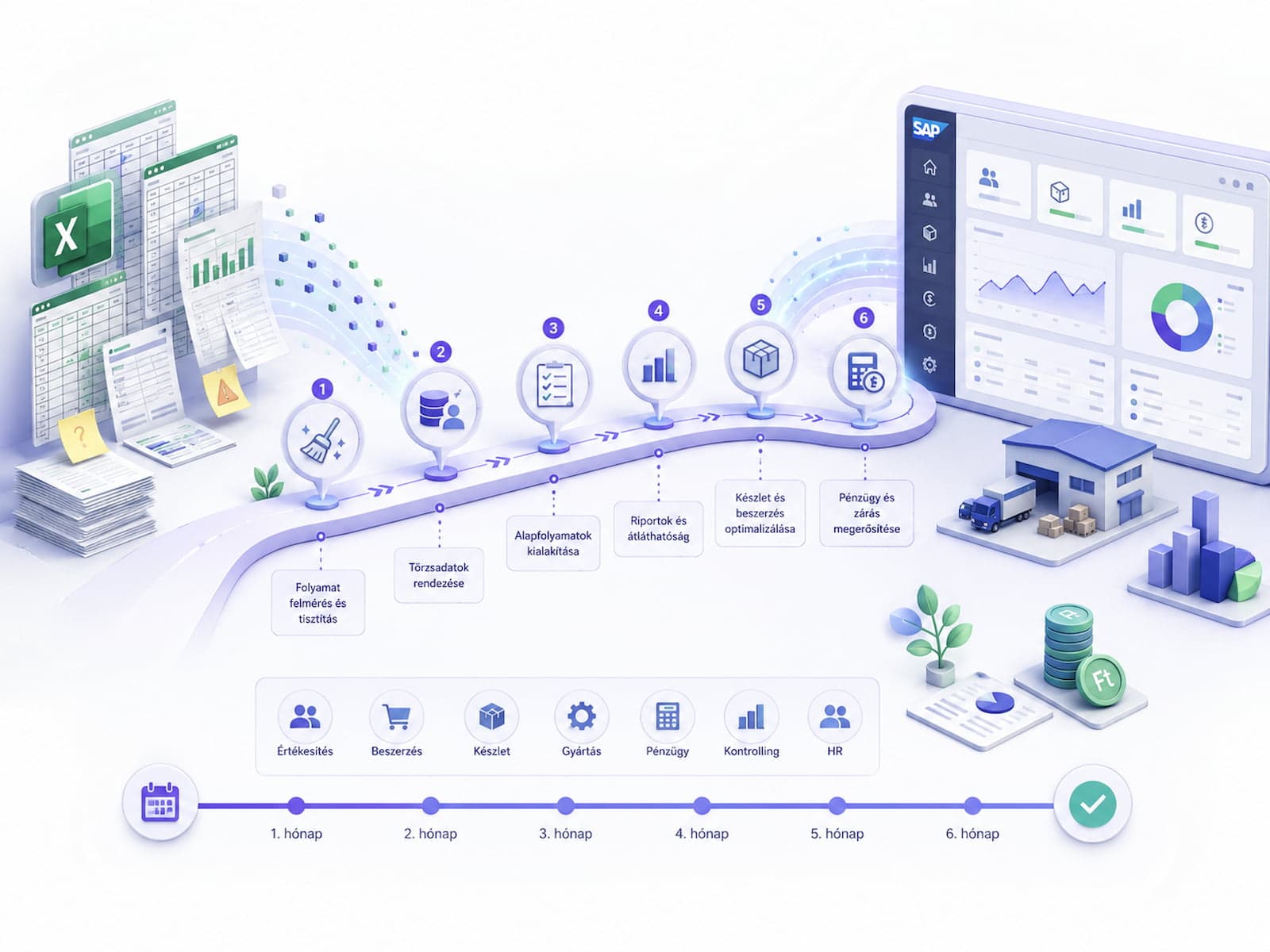
When does moving from Excel to SAP make sense? A six-month roadmap broken down by month, typical cost estimates and three real-world examples.
28 February 20269 min read
Read moreAn ECC to S/4HANA brownfield migration from the inside: master data cleanup, custom Z objects, integration mapping and the five biggest lessons learned.
Brownfield migration
SAP Readiness Check plus the Custom Code Migration App. 80 Z-programs scored green, yellow or red.
Business Partner harmonisation (customer + vendor = BP). Took 11 weeks against a 4-week estimate.
15 red Z-objects rewritten, 12 interfaces end-to-end tested. Four deprecated RFCs moved to OData / REST.
35-step runbook with parallelism analysis. Three sandbox dry-runs: 42h → 31h → 28h in production.
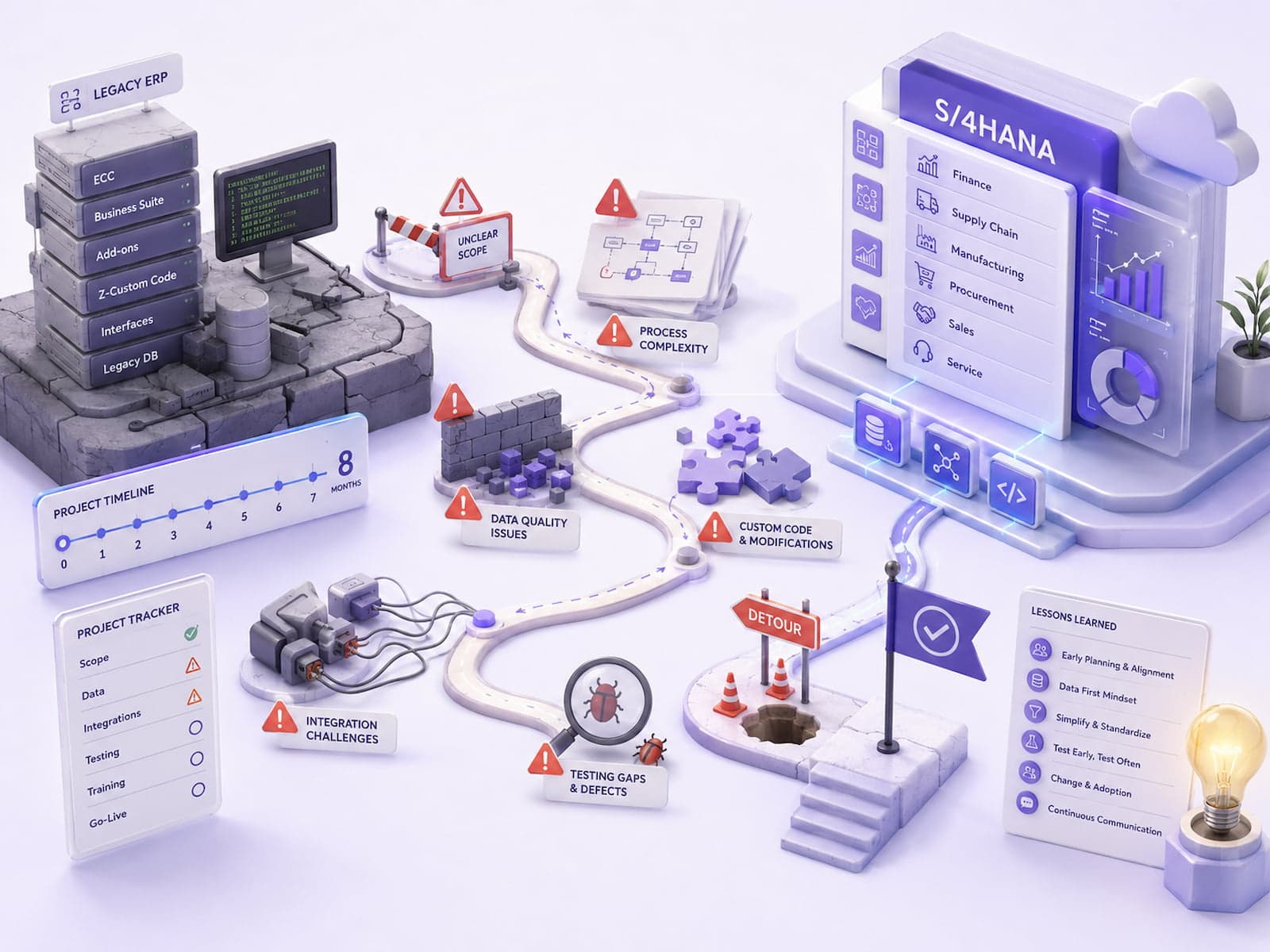
A larger Hungarian company's SAP ECC to S/4HANA brownfield migration, where we took part as a subcontractor. An 8-month project, with a 4-person core team on the client side and 2 people on ours. This article covers the 5 most important lessons learned, which may be useful to others. Plus the actual project timeline, the challenges, and what we would have done differently.
With SAP ECC end-of-mainstream-support approaching in 2027, 2026-2027 will see many similar brownfield migrations. This article offers concrete lessons to help with the preparation.
Anonymized: a mid-sized Hungarian company (250+ employees, over HUF 40 billion in annual revenue) had been running SAP ECC 6.0 for years. With ECC end-of-support arriving in 2027, it needed to migrate to S/4HANA — using a brownfield (in-place upgrade) approach so the existing customizing and data would be preserved.
Production (PRD)  — live SAP ECC system
                   ↓ brownfield upgrade weekend
Production (PRD)  — live SAP S/4HANA system

Quality Assurance (QAS) — UAT, regression testing
Development (DEV)       — customizing, transport
Sandbox (SBX)           — experiments, proof-of-concept
The difference between brownfield and greenfield: with brownfield, the existing customizing, master data and transaction history are all preserved. Greenfield means a new tenant plus a separate data migration.
| Month | Phase | Client side | Our side |
|---|---|---|---|
| 1 | Discovery | Audit, scope, sign-off | Audit support |
| 2 | Plan | High-level technical plan | Z-object audit |
| 3-5 | Master data cleanup | 3 people full-time | 1 person part-time |
| 6 | Custom code migration | 2 people (ABAP + functional) | 1 ABAP developer full-time |
| 7 | Integration testing | 3 people | 1 person part-time |
| 8 | UAT | 8 key users | UAT support |
| 9 | Cutover + hyper-care | All hands | 2 people full-time |
The original plan called for 8 months; the actual project took 9 (a one-month slip, mainly due to master data and Z-object rewrites — see lessons 1 and 2).
Original estimate: 4 weeks. Actual: 11 weeks. That is a 177% overrun on this workstream.
The "dirty" data that had accumulated in ECC 6.0 over the years:
S/4HANA's Business Partner concept is stricter: the old customer, vendor and employee records all merge into a single "Business Partner" entity. Where a company was both a customer and a vendor (intermediary companies), ECC held 2 separate records; S/4HANA needs 1 — so they had to be harmonized.
On top of that, S/4HANA enforces stricter validation (mandatory fields, formats) that the legacy data loaded into ECC could not satisfy.
1. Master data audit script (ABAP)
   → output: 12,000 anomalies (duplicates, inconsistencies, missing values)

2. Categorizing the anomalies:
   - High priority (customers, vendors, critical materials): 3,000 records
   - Medium (inactive, rarely used): 6,000 records
   - Low (irrelevant historic data): 3,000 records

3. Cleanup execution:
   - High priority: manual, dedicated 3-person team (client's finance +
     logistics + IT)
   - Medium: script-with-human-review
   - Low: anonymization and archiving

4. Test migration on the sandbox:
   - 3 iterations, a new cleanup batch after each
Plan for brownfield master data cleanup to take 2-3 times longer than your initial estimate. If discovery gives you "4 weeks," plan for 10-12.
80 custom Z programs. According to the SAP Custom Code Migration App's assessment:
| SAP App's original estimate | Actual outcome |
|---|---|
| 60 "green" (smooth) | 35 green |
| 15 "yellow" (minor changes) | 30 yellow |
| 5 "red" (major rewrite) | 15 red |
In the yellow and red bands, actual effort came out three times higher. The SAP App detects syntax-level breaking changes, but runtime semantics and side effects were consistently underestimated.
1. Prioritization
   → 5 most business-critical Z programs identified (e.g. a custom
     invoicing flow, a customs-clearance report)
   → these became release-blocker priority

2. Handling the remaining 75 Z programs:
   - 15 old Z programs decommissioned (unused, confirmed by the business
     owner)
   - 30 yellow Z programs rewritten (4-8 hours each on average)
   - 15 red Z programs rewritten from scratch (40-80 hours each on average)
   - 15 green Z programs handled by automatic adaptation

3. Tech debt backlog
   → the remaining 25 lower-priority Z programs moved to a post-go-live
     phase

4. Regression test framework
   → unit tests plus UAT-level regression testing for every Z program
| Z program | Function | Estimated → Actual |
|---|---|---|
| Z_VAT_REPORT_HU | Hungarian VAT return export | 16h → 24h |
| Z_BANK_SFTP_INTEGRATION | Bank transaction import | 24h → 48h (new OData flow) |
| Z_CUSTOMS_DECLARATION | Customs clearance report | 32h → 60h |
| Z_INVENTORY_BARCODE | Barcode-based inventory | 40h → 56h |
| Z_PRICING_LOGIC | Custom pricing rules | 56h → 88h (the biggest rewrite) |
The SAP Custom Code Migration App gives you a directional estimate, but it underestimates low-level (yellow/red) code rewrites. Budget an extra 50% for Z-object rewrite effort.
12 external interfaces:
According to the assessment, all of them were compatible. In reality: ECC used proprietary RFC modules on 4 interfaces, and those are deprecated in S/4HANA.
| Interface | Issue | Solution |
|---|---|---|
| Magento webshop | RFC-based custom BAPI | Rewritten as an OData service |
| K&H banking | Proprietary IDoc | XML-REST endpoint |
| Supplier EDI | Z-module RFC | SAP Integration Suite |
| HR portal (legacy) | Custom RFC destination | RESTful endpoint |
1. Discovery (after the fact): end-to-end test scenarios for all 12
   interfaces
2. Replaced the 4 problematic ones with OData/REST (modernizing them at
   the same time)
3. Added 3 weeks of scope, but it was worth it — the old RFCs had no
   long-term roadmap
Integration mapping cannot be done on paper alone — every interface needs to be tested in a test environment, on the sandbox S/4HANA system, during discovery. "Fine on paper" often turns into "uncertain at runtime."
Many small steps (35+), each in a strict sequence. Miss one and it means a rollback. The first dry run (test cutover) took 42 hours; that would not fit into the 36-hour production window.
Dry run 1 (sandbox):     42 hours
  Optimization 1:
  - 6 steps parallelized
  - 3 steps converted into scripts

Dry run 2 (sandbox):     35 hours
  Optimization 2:
  - Master data cache pre-warmed
  - Index rebuilds parallelized
  - Cutover cache invalidation scripted

Dry run 3 (sandbox):     31 hours

Production cutover:      28 hours
  (Friday 16:00 → Sunday 20:00)
Phase 1: Pre-cutover (Friday 16:00 → 20:00)
  - Old system frozen, user communication
  - Final data extracts
  - Sandbox validation

Phase 2: Database upgrade (Friday 20:00 → Saturday 12:00)
  - HANA migration prep
  - Schema conversion
  - Index rebuild (parallelized where possible)
  - Custom code activation

Phase 3: Master data load (Saturday 12:00 → 20:00)
  - Business Partner harmonization
  - Cleansed master data load
  - Validation scripts

Phase 4: Integration test (Saturday 20:00 → Sunday 08:00)
  - Each of the 12 interfaces tested end-to-end
  - Print queue and batch jobs verified

Phase 5: UAT sign-off (Sunday 08:00 → 14:00)
  - Verification by 8 key users
  - Walkthrough of critical scenarios

Phase 6: Go-live (Sunday 14:00 → 20:00)
  - User access enabled
  - Hyper-care war room active
  - Monitoring dashboard live
Run the test cutover at least twice, keep a documented runbook committed to git, and analyze what can run in parallel. The 35-step runbook itself lived as a Notion doc plus git-versioned SQL/ABAP scripts.
In the first 30 days, we typically saw 5-10 tickets a day. From day 31 onward, it was still running at 4-5 tickets a day. The scope only included 30 days of hyper-care — we had to request an extension.
Hyper-care timeline:
Day 1-30:  hyper-care phase 1 (full team, 5-10 tickets/day)
Day 31-60: hyper-care phase 2 (reduced team, 4-5 tickets/day)
Day 61-90: warm support (1 person part-time, on-call)
Day 91+:   standard maintenance contract
We held a post-go-live retro call every Friday — reviewing the tickets that had come in, categorizing them by priority, and writing runbooks for the 20 most common ticket types (for the client's support team to take over afterward).
| Rank | Issue | Resolution |
|---|---|---|
| 1 | "Old transaction code not found" | User training doc updated |
| 2 | "Understanding the new report format" | New training session |
| 3 | "Financial posting error on a custom flow" | Customizing fine-tuned |
| 4 | "Print form is wrong" | Form template updated |
| 5 | "Workflow approval is slow" | Performance tuning |
| 6 | "Banking integration is stuck" | Interface monitoring |
| 7 | "Duplicate stock write-off" | Master data fix |
| 8 | "Report export formatting in Excel" | XLS template fix |
| 9 | "RBAC: no access to X" | Authorization update |
| 10 | "Incorrect vendor data on invoice" | Master data correction |
Plan for 60 days of hyper-care on an S/4HANA brownfield migration. For an SME-sized project, 30 days may be enough — for an enterprise one, it is not.
| Metric | Before (ECC) | 6 months later (S/4HANA) |
|---|---|---|
| Critical incidents (P1) | 1-2 / month | 0 |
| High incidents (P2) | 5-8 / month | 1-2 / month |
| Report generation time (financial month-end close) | 4-5 days | 1-2 days |
| Performance (critical transactions, p95) | 3-5s | 0.8-1.5s |
| User satisfaction (internal NPS) | 5.2 / 10 | 7.2 / 10 |
| Master data accuracy | ~85% | ~98% |
| Audit findings (ISO 9001) | 12 findings | 3 findings |
The performance gains come from the HANA in-memory database (critical transactions run 30-50% faster). The improvement in user satisfaction comes from the new Fiori UI.
The 1-month discovery phase should have been 2 months. The assessments for master data, Z objects and integrations were all underestimated.
The 3-person master data cleanup team only started in month 3. Had it started in month 1, the entire project slip could have been avoided.
Testing all 12 interfaces happened at the end of the build phase — a dedicated 1-week sprint in month 5 would have helped.
The 180 users received their training invitations 30 days before go-live. That should have gone out 2 months earlier — actual training only started 1 month before go-live.
Of the 25 yellow and 15 red Z programs, 8-10 could probably have been solved with a standard best-practice flow instead. The argument "but this is how we've always done it" was sometimes accepted too readily.
Related articles from us: From Excel to SAP for SMEs — a greenfield implementation roadmap. AI implementation at Hungarian SMEs — ERP plus AI pipeline integration. How we work remotely — project management.
An S/4HANA brownfield migration is not a simple project. The name "in-place upgrade" is misleading — data migration and custom code refactoring can account for up to 50% of the total project effort.
The most important lesson from this anonymized project experience: build in buffer across all three critical areas — master data, custom code, integration. None of them can be estimated precisely during discovery, and all three tend to take 2-3 times longer than SAP's own tools predict.
If you're planning an SAP S/4HANA migration, let's start with a discovery call — the first month is exactly about identifying those buffer areas. A discovery cost of HUF 200,000-400,000 often saves you from HUF 20-50 million in scope creep later on.
About the author
Corevanix Kft.
Technology partner
Budapest-based technology partner — SAP/ERP integration, web development, AI automation and mobile app development. We work inside the client’s own environment, and the delivered code belongs entirely to the client.
When does moving from Excel to SAP make sense? A six-month roadmap broken down by month, typical cost estimates and three real-world examples.