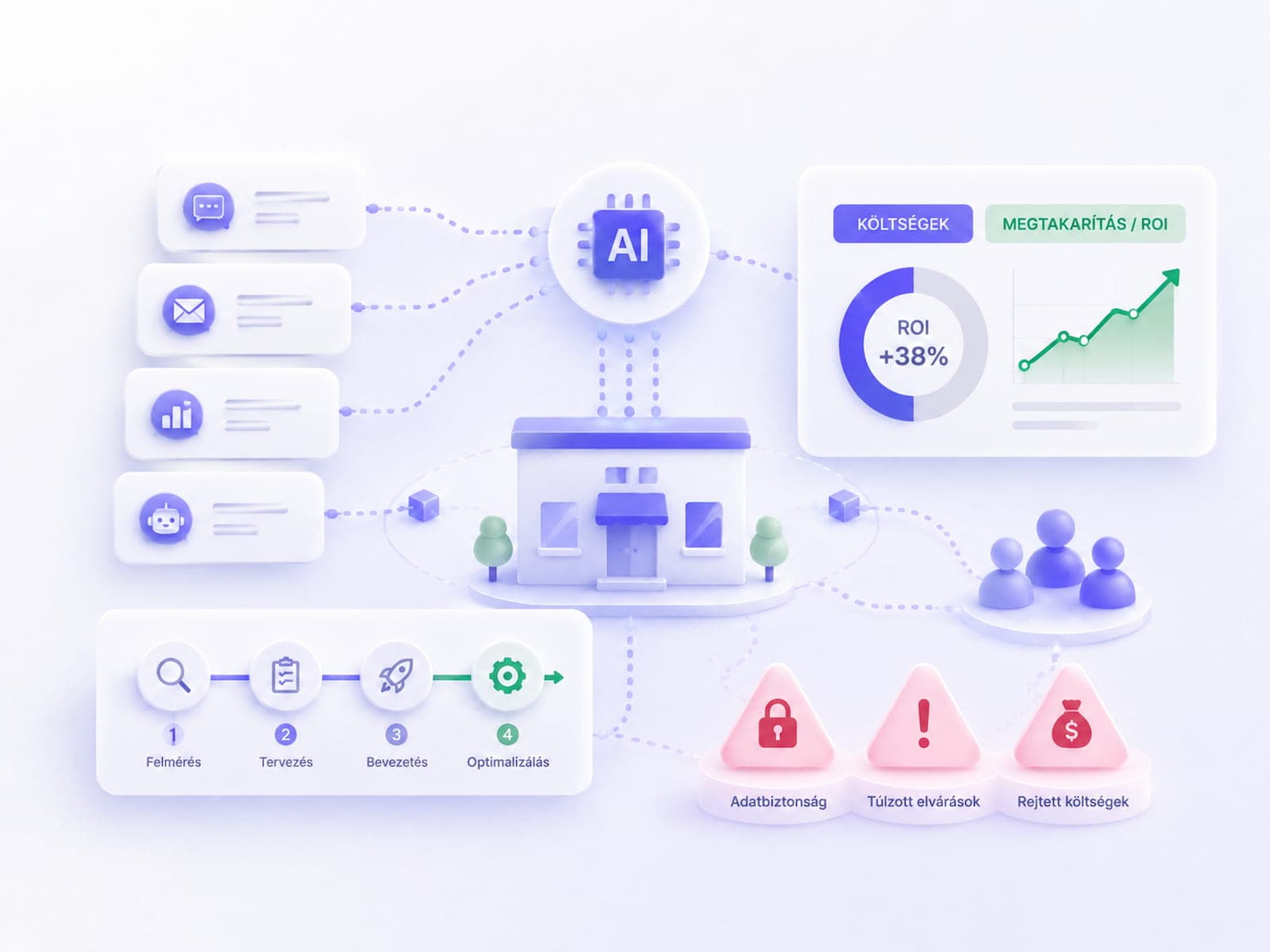
The "2025 was the year of AI" hype has faded. 2026 is the year of consolidation: SMBs are no longer debating "should we do AI," but "which use case is worth it." This article takes a grounded look at the Hungarian SMB market — maturity levels, the top use cases, costs, ROI, and what to avoid.
The figures and ratios below are trends we've pulled together from Corevanix projects and our wider partner network in Hungary — not a representative statistic, but operational, on-the-ground knowledge. We're working from an internal Q1 2026 review covering anonymized data from 8+ client projects.
AI maturity in Hungary, 2026
The Hungarian SMB sector currently splits into three segments based on AI maturity:
Group A — "still just looking" (roughly 60-70%)
The marketing team uses ChatGPT to polish landing page copy and occasionally draft emails. There's no structured AI project. Leadership is curious but cautious — they've read plenty of articles about both the hype and the failures, and they're in no rush to invest.
A typical line from a managing director: "I know AI is here, but I don't want to waste money on it — I'm waiting until it's clearer what it's actually good for."
Group B — "we have an AI project, we're trying" (roughly 25-30%)
A PoC or MVP has run on one specific use case. Typically: a lead classifier, a chatbot, a document summarizer. Production status is mixed — a lot of PoCs never make it to production. The "the demo went great, but it crashes in production" scenario is common.
The 2025 hype wave left a lot of Group B companies with projects stuck halfway — either the partner needs replacing, the scope needs clarifying, or both.
Group C — "we're running several AI systems in production" (roughly 5-10%)
Deployed AI systems with measurable ROI. Most of these are companies with strong in-house IT (their own dev team), and a few are supported by a consultancy. Typically a combination of a lead assistant, a document extractor, and an internal chatbot — 3-6 different AI pipelines running at once.
The trend is clear: the A → B transition is accelerating in 2026 (partly due to political and economic pressure — competitiveness, cost optimization), while B → C remains slower and riskier.
What determines the segment?
A few concrete factors we ask about during discovery:
- Size of the in-house IT team. Zero people → almost certainly A or early B. 3-5 people → B or C.
- Data maturity. Spreadsheet-driven operations → A. Structured CRM + ERP → B or C.
- Industry. Tech-adjacent (SaaS, e-commerce) → further ahead. Traditional (manufacturing, retail) → further behind.
- Leadership attitude. "What is this AI thing?" → A. "Where's the ROI?" → B. "How do we optimize our existing pipelines?" → C.
Note: No group is in a "bad" position. Group A companies are often waiting smartly — avoiding the "PoC junk" that plagues Group B. But the competitive gap could become noticeable by 2027 for companies still stuck in Group A in 2026.
Top 5 realistic use cases for SMBs
Not every AI trend is right for an SMB. The five below have demonstrated ROI in the Hungarian market. The figures are averaged from 8+ projects.
1. Lead classification and assistant
What it is: Incoming form submission or email → automatic categorization (technical / sales / complaint / spam), an urgency score, and a drafted follow-up email. The sales team just fine-tunes the draft and sends it.
Typical result: 30-60 minutes saved per salesperson per day. Lead response time improves from 18 hours to 4 hours. The share of responses under 90 minutes goes from 12% to 41%.
Typical cost: 1.5-3M HUF plus 50-100k HUF/month in operating costs. ROI in 6-12 months.
When NOT to use it: If your sales team is one person handling 20 leads a day in 15 minutes — the setup cost won't pay for itself.
Full case study: AI lead assistant for an automotive SMB.
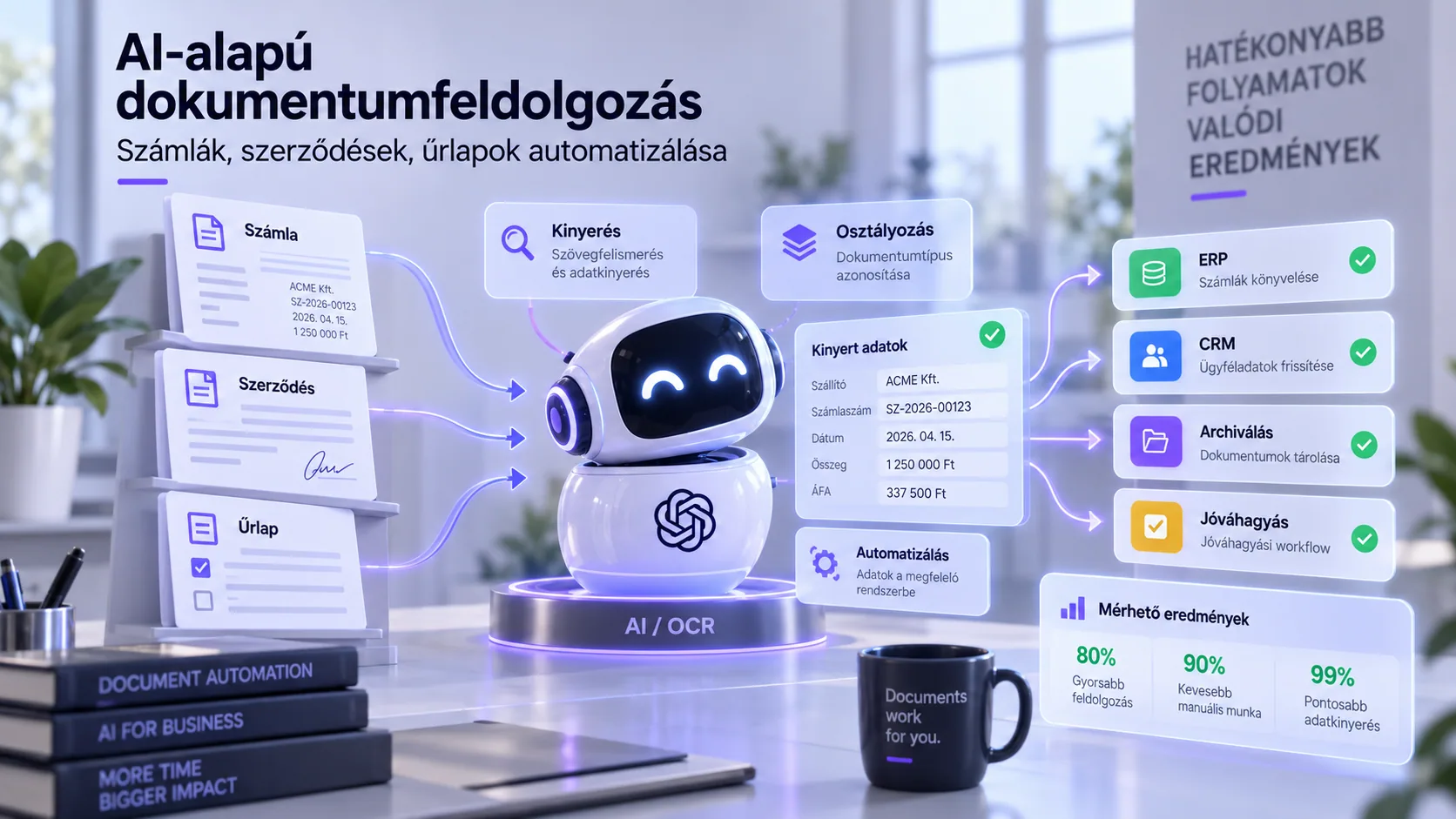
What it is: Invoices, contracts, minutes, waybills → structured data (extracted fields) → CRM / ERP / spreadsheet. PDF processing with OCR, followed by an LLM that extracts the data structure.
Typical result: 1-3 hours saved per day for the back office. A 70-85% drop in faulty data entry. Reporting turnaround shifts from a 1-2 day lag to real time.
Typical cost: 2-5M HUF plus 80-150k HUF/month (token cost). ROI in 4-8 months (faster than the lead assistant, because the time savings are more direct).
When NOT to use it: If your document volume is under 10 per week — the setup cost outweighs the savings.
3. RAG chatbot for an internal knowledge base
What it is: Internal documents (procedures, policies, knowledge base) → a chatbot that answers with source links. It takes routine HR / IT / finance questions off senior staff's calendars.
Typical result: 1-2 hours saved per day for HR / IT support. New-hire onboarding time shortens by 30-40% thanks to faster access to information.
Typical cost: 2.5-5M HUF plus 100-200k HUF/month. ROI in 8-14 months.
When NOT to use it: If your internal document corpus is under 50 pages — plain keyword search is simpler.
Full implementation guide: Building a RAG chatbot.
4. Customer support chatbot for a public product catalog
What it is: An FAQ chatbot for a webshop or SaaS product. It auto-closes 30-40% of support tickets and categorizes and routes escalated tickets to the right agent.
Typical result: 30-40% of support tickets auto-close. Average first-response time drops from 4-6 hours to 30 seconds. CSAT stays flat or dips only slightly.
Typical cost: 2-4M HUF plus 80-200k HUF/month. ROI in 6-10 months.
When NOT to use it: If your product catalog and usage context are too complex (enterprise-focused B2B software) — the chatbot ends up frustrating users.
5. Email summarizer and follow-up suggestions
What it is: Long email threads → a summary → action items → suggested replies. For sales / account management teams. The "summarize a 14-message email thread in 30 seconds" use case.
Typical result: 30-45 minutes saved per day for account managers / senior sales staff. Fewer overlooked emails (dropped tickets).
Typical cost: 1-2M HUF plus 30-80k HUF/month. ROI in 6-9 months.
When NOT to use it: If your sales workflow runs primarily through Slack with email as a secondary channel — the savings are smaller.
Five use cases we don't recommend (yet)
A few AI use cases we do not recommend for SMBs in 2026 (yet):
- Autonomous AI agents (LangGraph, AutoGen). Impressive at the PoC stage, flaky in production.
- "Generative design" for product photography. Stable Diffusion + ComfyUI has a steep learning curve, and free-tier online tools (Midjourney) often produce better results anyway.
- Voice bots for customer service. Hungarian-language speech recognition and TTS in 2026 still aren't native-quality — this works better in English-language markets.
- Real-time video moderation. Expensive, risky, and in the Hungarian market the regulatory questions (GDPR, child protection) create more complications than ROI.
A typical cost breakdown
Here's the cost breakdown for a mid-complexity AI project (e.g., a lead assistant) at Q1 2026 pricing:
| Item |
Cost (HUF) |
Note |
| Discovery (1-2 weeks, fixed fee) |
200-400k |
Process mapping, eval set, scope |
| Build (6-10 weeks, T&M or fixed) |
1.5-3M |
Frontend + workflow + AI integration |
| Hyper-care (30 days) |
included in the build |
Weekly monitoring, fine-tuning |
| Monthly operations (us, post-hyper-care) |
50-150k |
Prompt tuning, eval set maintenance |
| LLM API token cost (OpenAI/Anthropic) |
30-150k/month |
Depends on volume |
| Vector DB / infra hosting |
10-50k/month |
Supabase / self-hosted Postgres |
| Third-party tools (CRM, SMS, monitoring) |
5-30k/month |
Depends on provider |
Entry-level net project cost: 1.7-3.4M HUF.
Annual operating cost: 1-4M HUF.
Why the cost varies so much
Why isn't there a flat 2.5M HUF price for everything?
- How much data prep is needed. If discovery reveals 800 emails that need manual labeling → +1 week, +400k HUF. If an eval set already exists → -400k HUF.
- Integration complexity. A standard HubSpot REST API integration takes 2 days. A custom SAP/ERP interface takes 1-2 weeks.
- Team buy-in. If the sales team resists, the soft-launch phase adds 2 weeks.
- Hungarian-language-specific tuning. Fine-tuning the eval set adds 2-3 prompt iterations, +1 week.
ROI math with a concrete example
For a lead assistant project with a 4-person sales team:
Time saved:
  30 min / person / day x 4 people x 220 working days = 440 hours / year

Value of a sales hour (fully loaded cost):
  12-18k HUF / hour (average 15k)

Direct time savings:
  440 x 15k = 6.6M HUF / year

Project cost:
  3M HUF build + 1.5M HUF / year operating = 4.5M HUF (year 1)

Year 1 ROI (direct time savings only):
  (6.6M - 4.5M) / 4.5M = 46%

Year 2+ ROI:
  (6.6M - 1.5M) / 1.5M = 340%
That's direct time savings only. On top of that, there's often a revenue impact too:
Revenue impact (indirect)
Faster lead response (18 hours → 4 hours) can drive conversion gains. Based on our discovery data:
- Share of responses within a 90-minute window: baseline 12% → 41%. In B2B industries, responding within a 90-minute window correlates with a 15-25% higher conversion rate (Harvard Business Review, "The Short Life of Online Sales Leads," 2011 — still holds up today).
- If annual lead volume is 5,000, average deal value is 200k HUF, and baseline conversion is 5%:
- Baseline revenue: 5,000 x 5% x 200k = 50M HUF
- +20% conversion uplift on the 30% of volume that moved (12% → 41%): 5,000 x 30% x 5% x 1.2 x 200k = 18M HUF additional
- Net additional revenue: roughly 3-5M HUF (the full 18M is only partially attributable, since not every conversion can be traced back to this)
This is a conservative estimate. The revenue impact is often 2-5x the direct time savings.
Total ROI
For a mid-sized project:
- Direct time savings: 5-8M HUF/year
- Revenue uplift: 2-5M HUF/year
- Total: 7-13M HUF/year in benefit
- Year 1 project cost: 3-5M HUF
- Year 1 ROI: 40-160%, year 2+: 350-700%
Tip: ROI estimation is part of discovery. Don't take on a project without an ROI estimate — having a number forces the partner to set concrete, measurable goals instead of vague talk about "digitalization."
Three anonymized real projects
Example 1: Automotive SMB — lead assistant
A four-month project, roughly 3M HUF build cost, roughly 125k HUF/month operating. Lead response went from 18 hours to 4 hours, with 35-40 minutes saved per day for the sales team. Year 1 ROI: roughly 80%.
Full case study: AI lead assistant for an automotive SMB.
A three-month project, roughly 2.5M HUF build cost, roughly 150k HUF/month operating. OCR plus LLM extraction on 50-80 waybills a day, feeding into the ERP. 2-3 hours saved per day for the back office. Year 1 ROI: roughly 120%.
The challenge: waybills came in 12 different layouts (from different carriers). The eval set had 200 items, balanced across all 12 templates.
Example 3: B2B SaaS — RAG support chatbot
A 2.5-month project, roughly 2.2M HUF build cost, roughly 110k HUF/month operating. Built on 300+ pages of internal product documentation. 32% of support tickets auto-close; CSAT stayed flat (not a regression — worth noting it didn't improve either, but the time savings for the support team more than made up for it).
Year 1 ROI: roughly 75%, year 2: roughly 300%.
The challenge: the product documentation changes fast (weekly releases), so the vector DB had to be updated incrementally.
What not to do — five common mistakes
1. Don't start with an "AI strategy"
Asking "what's our AI strategy" is too abstract for 2026 — start with concrete use cases, calculate ROI, and iterate. Strategy emerges from experience with use cases, not the other way around.
"AI strategy workshops" were a popular consultancy product in 2024-2025, and the 2026 experience is that 70-80% of them end up as shelf-ware — finished, but never actually helping the company.
2. Don't build an in-house AI team from zero for one use case
A senior AI engineer costs 1.5-2.5M HUF/month, and recruiting alone takes 3-6 months. Add benefits, tooling, and the need to train junior staff. For a single four-month project, that's a minimum cost of 12-15M HUF — it doesn't pay off.
A consultancy or outsourcing partner can get something live in 6 weeks. It may make sense to bring things in-house by your third or fourth AI project — but not before the first.
3. Don't get caught up in the "autonomous AI agent" hype on a production-critical path
The 2026 agent frameworks (LangGraph, AutoGen, CrewAI) are impressive at the PoC stage, but still flaky in production. A multi-step agent handling a simple task can burn through 5-10 LLM calls, and errors compound — 90% accuracy at each step becomes 59% reliability across a 5-step pipeline (0.9^5 = 0.59).
A single-step LLM call combined with a well-designed workflow is more stable. A hand-coded 5-step pipeline built on n8n or a similar orchestration platform delivers 95-98% reliability on the same task.
Note: Using autonomous agents in production is still R&D territory in 2026. If a partner is trying to sell you an "AI agent solution" for a production workflow, ask what happens when it hallucinates on step 4 — and what the recovery path looks like. The typical answer is "we're still working on that."
4. Don't trade data protection for speed
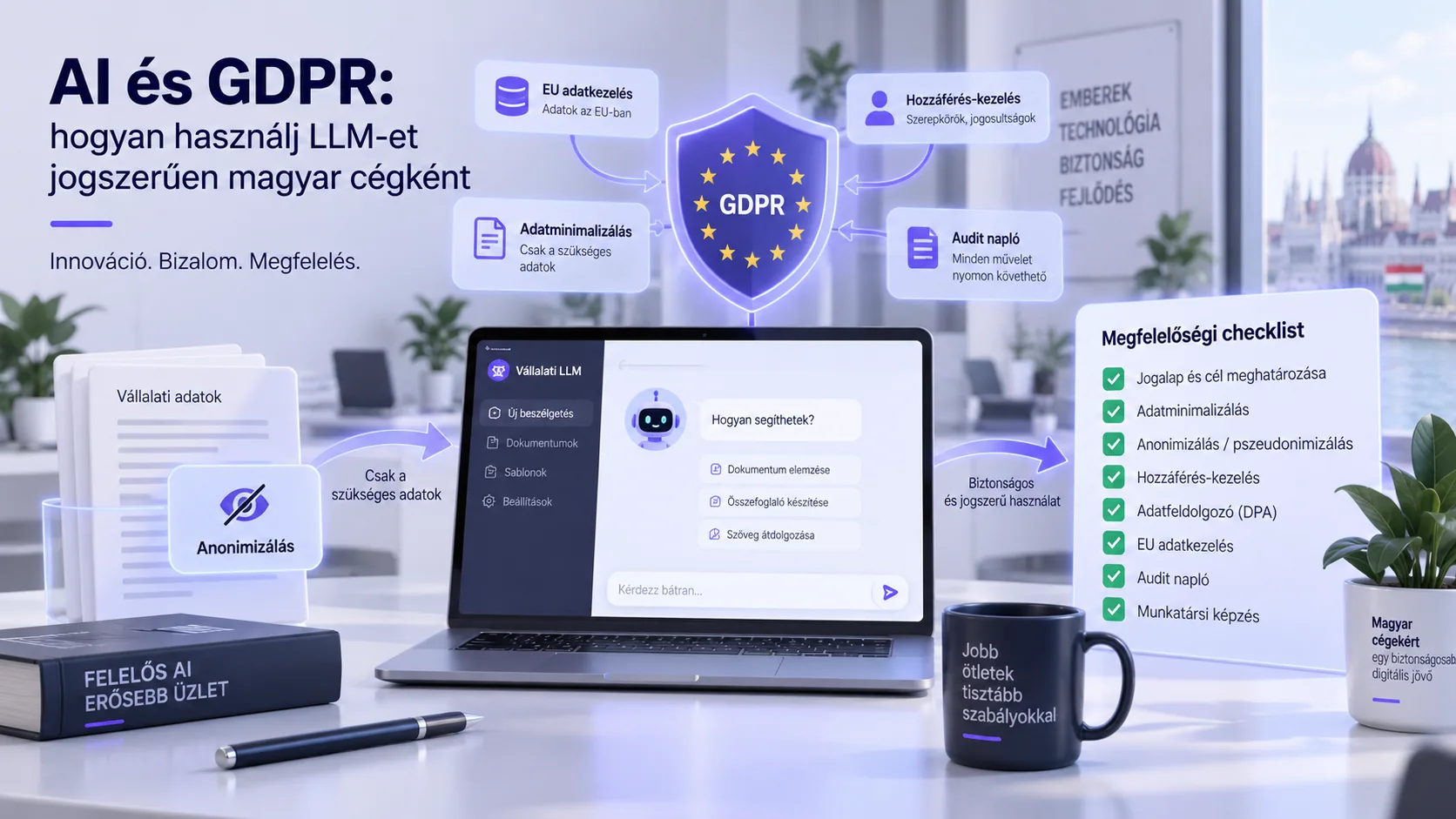
Enterprise OpenAI / Anthropic tiers offer an explicit no-training opt-out, and European data residency is available. The "we can't use this because of GDPR" objection generally doesn't hold up anymore in 2026 — but setting it up properly (signing a DPA, a BAA, regional configuration) takes time.
The "move fast, worry about GDPR later" approach tends to fail within 1-2 years — through a user complaint or an audit by the National Authority for Data Protection. Fines have been getting stricter in Hungary since 2024.
5. Don't skip measuring accuracy
Without an eval set, you don't know whether your system is running at 70% or 95%. That 25-point gap is huge in terms of customer experience — a 70% system draws a complaint on every third response; a 95% system draws one on every twentieth.
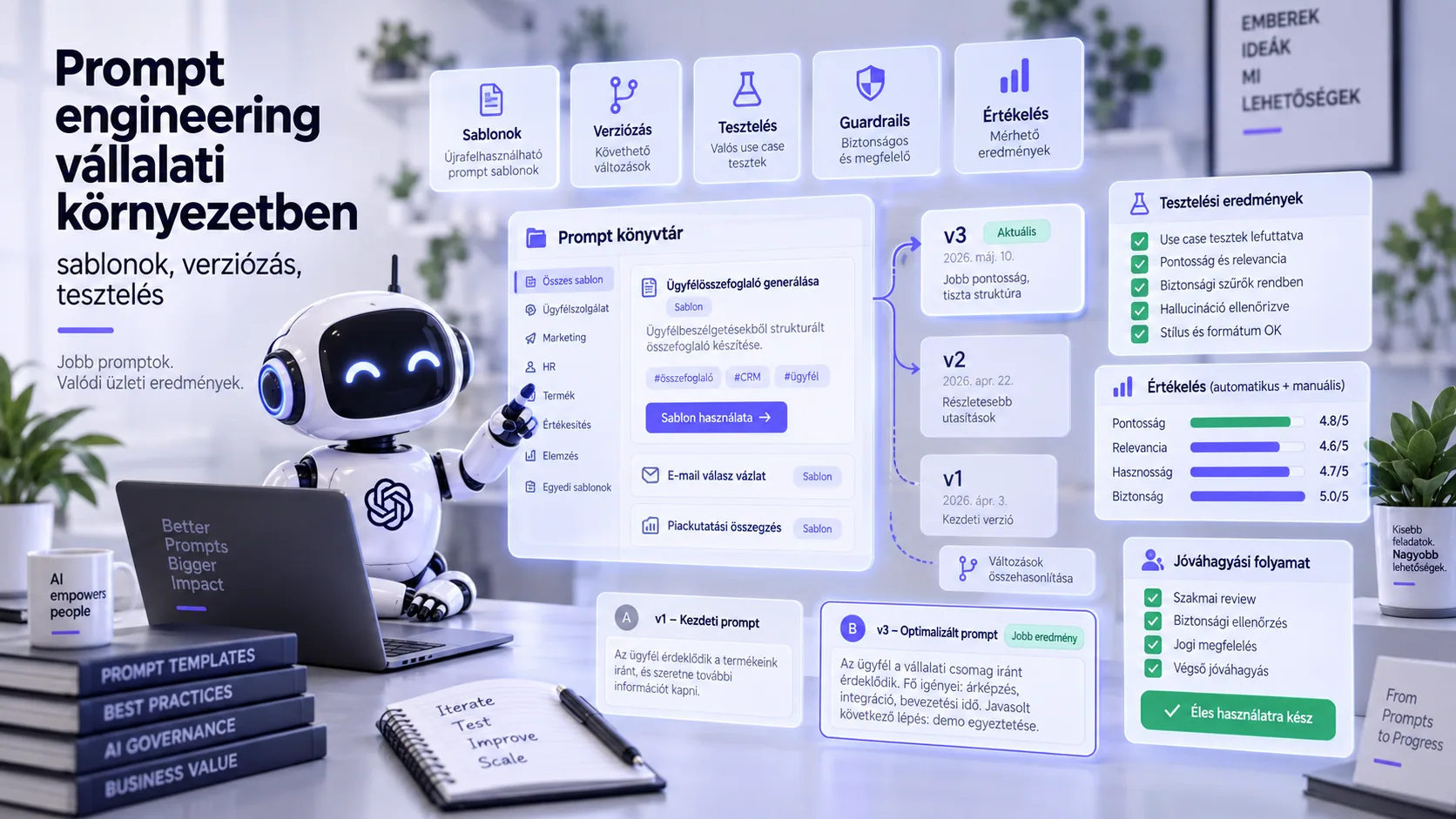
Maintaining the eval set is the backbone of the project. Full guide: 7 defenses against LLM hallucinations.
Getting started — the first 30 days
If you're an SMB just stepping into the AI space:
Week 1 — discovery
List your top 5 manual, repetitive workflows that eat up 1-2+ hours a day. These are your target use cases.
A concrete workshop format: a 90-minute meeting with leadership plus one-on-one, one-hour interviews with operational team members. The output is a list where every item includes:
- How much time per week it takes manually
- Its monetary value
- How repetitive it is (how recognizable the pattern is)
- How critical it is (how costly a mistake would be if the AI got it wrong)
Week 2 — partner search
Talk to 2-3 consultancies or dev shops. Ask for a free 30-60 minute discovery call. Evaluate candidate partners on three criteria:
- Reference projects in the SMB segment. An enterprise-focused partner is too heavyweight and too expensive.
- Focus on eval sets and measurement. If a partner doesn't bring up the eval set on the first call, that's a red flag.
- Experience with Hungarian-language projects. "A prompt tuned for English-language marketing" is a classic Central-European pitfall.
Week 3 — PoC scope
Run a 1-2 week fixed-price PoC with the most suitable partner. Goal: a working prototype for your top use case. The PoC scope should include:
- One concrete workflow (e.g., lead classification)
- A 50-example eval set
- A single-pipeline implementation
- A demo-level UI or dashboard
Typical PoC cost: 400-800k HUF. If it costs more than that, be suspicious.
Week 4 — go/no-go
Use the PoC results to decide: continue to an MVP (8-10 weeks) or stop and try the next use case. The go criterion: at least 75% accuracy on the PoC eval set, with the partner projecting at least 90% at production scale.
A six-month AI roadmap for SMBs
The five months after your first 30 days:
| Month |
Phase |
Output |
| 1 |
Discovery + PoC |
Top use case selected, PoC run |
| 2 |
MVP build (use case 1) |
Production deployment, hyper-care |
| 3 |
Hyper-care + PoC 2 |
Use case 1 stable, PoC for use case 2 starts |
| 4 |
MVP 2 + retrospective on use case 1 |
Use case 2 in production, lessons learned from use case 1 |
| 5 |
PoC 3 or scaling use case 1 |
Expansion in the next direction |
| 6 |
Consolidation |
2-3 use cases live, team buy-in |
Official docs and further reading
Related articles from us: AI lead assistant case study — a real, live project. Building a RAG chatbot — implementation guide. 7 defenses against LLM hallucinations — a production-quality framework. n8n vs Zapier vs Make 2026 — choosing an orchestration platform.
Closing thoughts
The Hungarian SMB market is ready for AI implementation in 2026 — but success takes a concrete use case, measurable ROI, and a discovery-first mindset. The "rewrite everything with AI" approach almost always backfires.
Based on what we've seen in 2026: whoever starts now — with 1-2 well-measured use cases, iterating along the way — will be in Group C by 2027. Whoever waits will start feeling the competitive gap by 2028.
If you're thinking about an AI use case, let's start with a free 30-minute discovery call — afterward you'll know exactly whether it's worth pursuing. A 1-2 week PoC typically makes it clear whether AI brings real value to your use case, or whether it's just hype.